G★★★★★4.8453 verified repairs across our Bay Area network
Redwood City Sub-Zero Service Desk
Sub-Zero alarms are clues, not universal repair codes
A Sub-Zero alarm in Redwood City is read by your model and serial tag, not a generic universal chart, because the same display behavior routes differently across 600/700-series, BI built-ins and integrated columns. We tie the alarm to compartment readings, thermistor checks and condenser airflow before any board is blamed.
This page avoids universal code charts unless the meaning is verified by your model and serial. For a Redwood Shores or Emerald Hills Sub-Zero, useful appointment details include the alarm text, model tag, current compartment temperatures, any recent power or door event, and whether the alarm returns after a reset.
What does a Sub-Zero error code or alarm mean in Redwood City?
For a Downtown, 94063 Sub-Zero, Redwood City Sub-Zero Repair reads the alarm by model and serial, not a universal chart, then ties it to compartment readings, thermistor checks and condenser airflow before any board is blamed. Photograph the alarm, then dial (650) 437-1838 for a Downtown Redwood City diagnostic.
Alarm evidence: a display warning is matched to model, readings and sensor checks before a board is blamed.
Sub-Zero error codes & alarms list (Redwood City)
A plain-language list of the Sub-Zero alarms and display behaviors we see most across Redwood City, from Redwood Shores to Emerald Hills. It is a reasoning aid, not a code dictionary — exact meanings differ by model and serial, so verify the real behavior against your rating plate before acting.
Alarm / display behavior
What it usually points to
What to do
Flashing or solid “Service” indicator
A stored fault, sensor input or control-board condition; the meaning varies by model family, so verify by model/serial.
Photograph it, leave power on, and confirm against your tag before any reset.
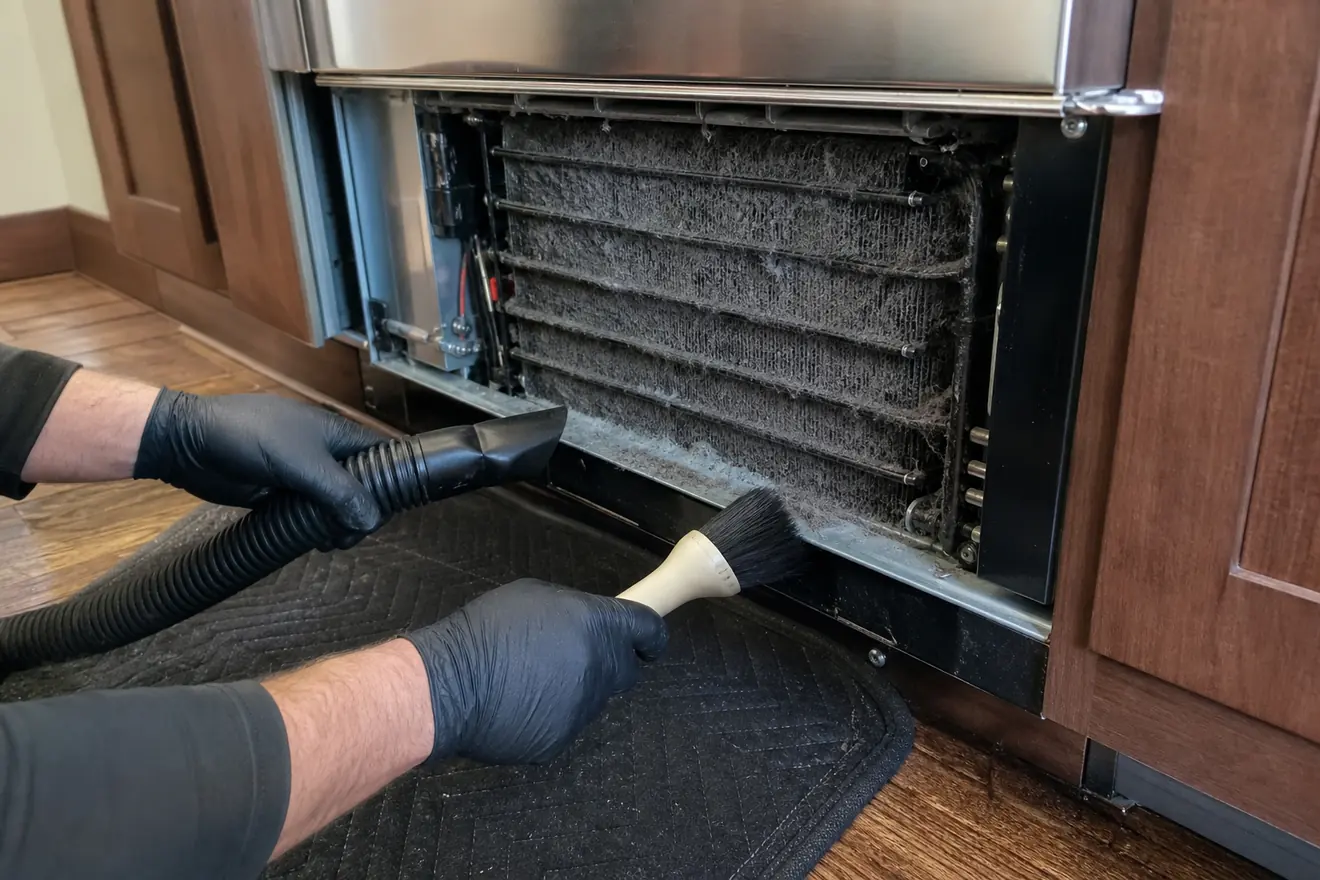
“Vacuum Condenser” reminder or unusually long run times
Condenser packed with dust restricting airflow — common in Emerald Hills and older Farm Hill kitchens where coils load fast.
Pull the lower grille, check the condenser, and re-probe cycling after a clean.
Frost line or condensation at the door edge
Door gasket leak or seal swelling, frequent where Redwood Shores waterfront humidity works the seals.
Paper-drag test and seal inspection; serial-matched OEM gasket or hinge adjustment.
Over-temp / high-temp alarm after a long door-open
Normal recovery, or a marginal temperature sensor.
Allow a full recovery cycle, then re-probe before replacing a thermistor.
Fresh-food warm while the freezer still holds
Evaporator fan, frosted coil or air damper — not necessarily the sealed system.
Watch fan rotation and airflow; defrost, fan or damper repair as measured.
Blank, frozen or unresponsive display
Control board, ribbon connector or power supply.
Confirm supply voltage; reseat or replace the confirmed board, and avoid repeated power-cycling.
Newer Sub-Zero models may show an EC-style electronic code; the meaning is model-specific, so read it against your model and serial rather than a generic chart. Photograph the alarm, then call (650) 437-1838 before resetting.
Quick answer
Direct answer for Redwood City Sub-Zero owners
Clear, up-front answers on the symptom, price range, timing and the next diagnostic step — no digging required.
Does an alarm mean the board is bad?
No. A Sub-Zero alarm can point to door history, condenser restriction, airflow, thermistor, gasket, control or sealed-system evidence. The board should not be quoted until model-specific checks and readings support that branch.
Model and serial control how alarm meaning is interpreted.
Fact 3
High-temperature alarms need current readings and door-history context.
Fact 4
A reset can hide useful timing when temperatures keep drifting.
Cost and timing table by diagnostic path
Published Redwood City planning ranges below are written as extractable service facts. They are not a final quote until model, serial, symptom evidence and access are checked.
Service or symptom
What includes
Price range
Typical time
Thermistor or sensor alarm
Sensor evidence, wiring check, model lookup and post-repair reading verification.
Alarm photo, reset timing, current readings, model-specific meaning and safety triage.
$135-$205
50-95 min
High-temperature alarm with airflow issue
Condenser airflow, fan behavior, grille heat and recovery check.
$390-$1,310
1-3 hours
Compressor / sealed system
False-positive checks, qualified electrical or pressure evidence, access planning and sealed-system quote conditions.
$1,475-$3,520
2.5-6.5 hours plus parts lead time
Door gasket / frost-line repair
Compression test, hinge reveal check, serial-matched gasket path, panel alignment notes and recovery verification.
$375-$910
1.5-3.5 hours
Final price rule: Final Redwood City price depends on model and serial range, symptom evidence, ZIP/access constraints, part availability and whether cabinet-safe movement is required.
Symptom to evidence to likely branch
Symptom
Evidence to collect
Likely branch
Related page
Fresh-food warm while freezer holds
Separate temperatures, evaporator fan and condenser airflow.
Airflow, damper, thermistor or control path before compressor.
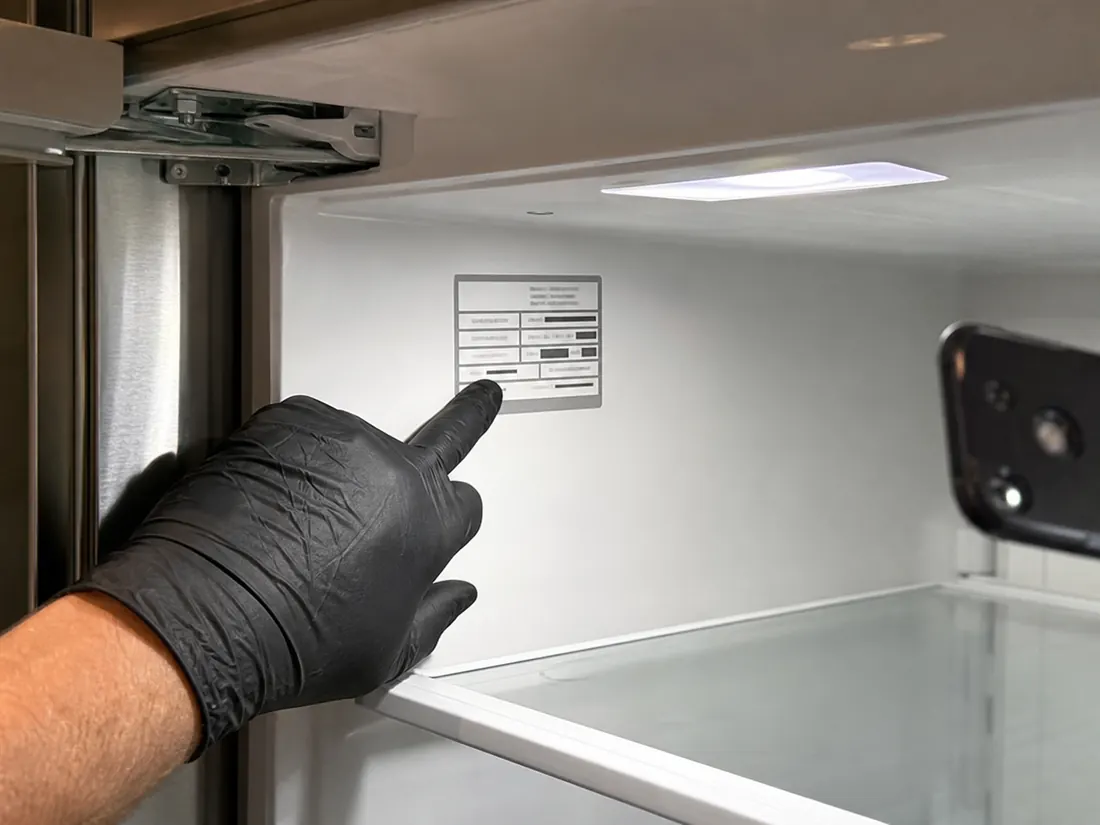
The model tag does not diagnose the failure, but it prevents the visit from starting with the wrong fan, gasket, valve, board or wine-zone sensor.
Sub-Zero family
Common tag location
Why it changes the quote
BI built-in series
Often inside the fresh-food compartment near an upper frame or side wall.
Fan, damper, thermistor and gasket part paths can change by serial range.
600 / 700 series
Often inside the compartment or near a hinge/grille area, depending on generation.
Older model ranges may need superseded parts or more careful cabinet access planning.
IT / IC integrated columns
Usually inside the column compartment or near an interior frame where it can be photographed safely.
Panel style, column layout, fan path and sensor placement affect timing and parts.
PRO and large built-ins
May require a wider interior photo if the tag is not readable without moving food.
Service planning should include floor protection, door swing and access weight.
Undercounter and wine storage
Often on an interior wall, frame or drawer area; do not force trim to expose it.
Zone sensors, fans, controls and door gaskets are especially model-specific.
ZIP and neighborhood service notes
Local notes are diagnostic and access context. Redwood Shores humidity, Emerald Hills access, downtown service windows and older remodels can change what should be discussed before the visit.
ZIP / neighborhood
Access or diagnostic note
What to have ready
94061 / Farm Hill / Mount Carmel
Older remodels and panel-ready kitchens make model-tag and door-reveal photos useful before the visit.
Ask for model/serial, fresh-food and freezer readings, and whether the unit was recently moved.
94062 / Emerald Hills / Edgewood Park
Hillside access and custom cabinetry can change appointment length and cabinet-safe pull planning.
Flag parking, steps, floor protection and whether a second person may be needed for movement.
94063 / Downtown / Courthouse Square
Condos, compact kitchens and service windows make pre-call details valuable before route scheduling.
Have model-tag, alarm, grille and water-line details ready when access is tight.
94065 / Redwood Shores
Waterfront humidity, high-use kitchens and wine storage can show moisture, ice and drift complaints.
Separate water-side evidence from temperature-side evidence to prevent the wrong part path.
94064 / business-route timing
Short access windows make answer-first booking details more important than a broad service-area promise.
Use the phone or online booking page with symptom, ZIP, model and urgency ready before the appointment window is offered.
What homeowners can safely check
Safely photograph the alarm, record temperatures and note recent power events, door-open events, cleaning or filter changes. If the alarm returns after reset, include how long it took and whether cooling changed.
Do not keep resetting without recording the pattern. Do not open control areas or assume a universal code chart applies to every Sub-Zero model family.
Diagnostic process before quoting
Photograph the alarm text before reset and write down how long it took to return.
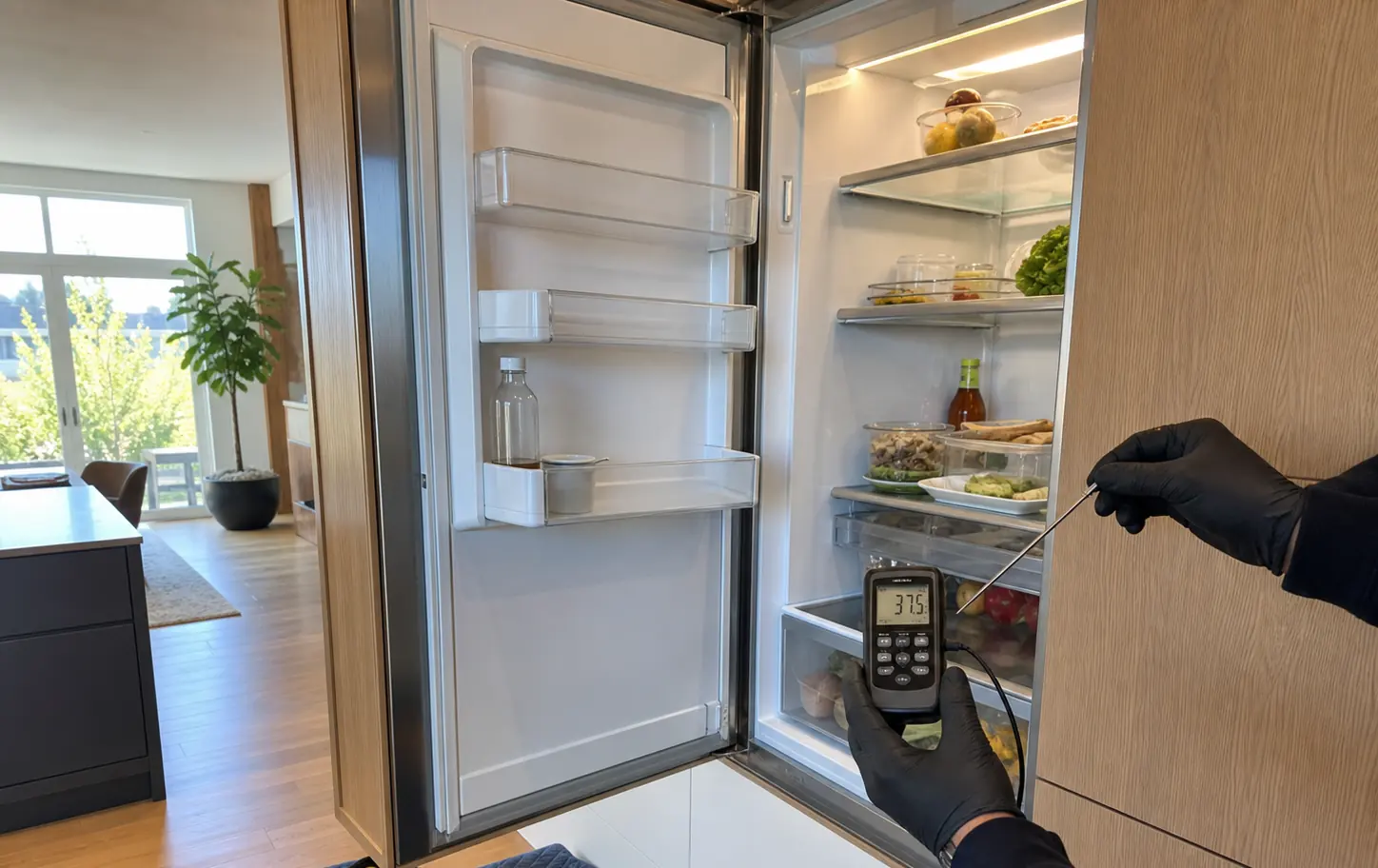
Record fresh-food, freezer or wine-zone temperatures so the alarm is tied to real readings.
Match alarm meaning to model and serial instead of using a universal code chart.
Check door history, condenser airflow, gasket behavior, sensors and wiring before a board quote.
Quote sensor, control, airflow or sealed-system branches only after the alarm evidence agrees.
Verify that the alarm stays clear after temperatures and the repaired branch stabilize.
Redwood City Sub-Zero diagnostic examples
These examples show how a Redwood City Sub-Zero visit is worked from the first symptom to the likely outcome, and the evidence each repair leaves behind.
Example diagnostic scenario: Emerald Hills fresh-food warming
A BI-style built-in is described as warm in the fresh-food section while the freezer still holds. The useful first visit records both compartment temperatures, checks condenser airflow, confirms fan response and photographs the model tag before discussing a board or compressor path.
Outcome frame: Likely time: 1-3 hours when the branch is airflow, fan, thermistor or seal; second visit only if a serial-matched part is needed.
Example diagnostic scenario: Redwood Shores ice and moisture
A Redwood Shores kitchen reports hollow cubes plus door condensation. The note separates water-side evidence from cold-side evidence: fill tube, inlet valve, freezer temperature, gasket compression and water-line routing are all checked before an ice maker assembly is ordered.
Outcome frame: Likely time: 1-3 hours for accessible water-path work; longer when valve access or cabinet movement is required.
Example diagnostic scenario: Mount Carmel frost line
A panel-ready door shows a frost stripe near one corner. The visit checks hinge reveal, panel weight, paper-strip compression and the exact gasket profile by model and serial, then verifies temperature recovery after the door closes cleanly.
Outcome frame: Likely time: 1-3 hours if the correct gasket or hinge path is available.
Example diagnostic scenario: Edgewood Park cabinet-safe pull
A sealed-system suspicion requires deeper access, but the built-in sits tightly in custom millwork. The note should document floor runners, protected cabinet edges, water-line slack and why accessible checks were not enough before movement.
Outcome frame: Likely time: 2.5-6.5 hours plus parts lead time when qualified sealed-system verification remains necessary.
G4.8 / 5453 verified repairs across our Bay Area network
Alarm and control-diagnosis reviews
The excerpts on this page focus on alarm timing, reset history, sensor evidence, control boards and high-temperature warnings.
★★★★★
Alarm matched to readings before board quote
The display alarm on our Edgewood Park built-in came back every six hours while the fresh-food side sat at 45 °F. The technician photographed the alarm, checked the thermistors and wiring, and only replaced the control board once the evidence matched. The $1,085 repair took 3 hours and the alarm has stayed off.
★★★★★
Reset history helped the diagnosis
We had cleared the alarm twice before calling from Farm Hill, but we kept notes on the timing and the temperatures each time. The technician used that pattern, the model tag and live sensor readings to land on a bad thermistor. It came to a $455 repair instead of a full control board.
★★★★★
High-temp alarm was airflow
A high-temperature alarm popped up after a warm afternoon at our Emerald Hills place and the freezer had climbed to 15 °F. Rather than jumping to electronics, the technician checked the condenser airflow first and found the fan had quit. The condenser-fan repair cost $735 and brought the freezer back down to 0 °F.
Photo evidence this page expects
Condenser evidence: restricted airflow can imitate a major cooling failure until the coil and fan are checked.Model-tag evidence: serial range controls gasket, fan, board, valve and ice-maker compatibility.First evidence: separate fresh-food and freezer readings before any compressor or control-board assumption.
Need a Redwood City Sub-Zero diagnostic?
Call (650) 437-1838 or use online booking. Have the model number, current temperatures, symptom and Redwood City neighborhood ready for the appointment conversation.
You can share the alarm text and photo, but exact interpretation depends on model and serial. A phone description is useful for routing, not for proving a failed board. The visit should connect alarm behavior to readings and physical checks.
When is an alarm urgent?
An alarm is urgent when it repeats with rising temperatures, appears with electrical smell, water near controls, repeated tripping or fast food-temperature loss. Stable alarms after a known door-open event may still need attention, but the timing should be captured first.
Should I reset the alarm before calling?
Photograph the alarm first, then note temperatures and how long it took to appear. A reset can be useful only if the pattern is documented. Repeated resets without readings can hide the timing that helps diagnose the branch.
Does an alarm mean the control board failed?
No. An alarm can reflect door history, condenser restriction, sensor drift, gasket leakage, control logic or sealed-system evidence. Board pricing should appear only after model-specific checks and readings support that branch.
When is an alarm a safety concern?
Treat it as urgent when it repeats with rising temperatures, water near controls, electrical smell, repeated tripping or fast food-temperature loss. Stable alarms after a known door-open event may still need attention, but capture the pattern first.
Why do model and serial matter for alarms?
Sub-Zero alarm meanings vary by family and control revision. The same display behavior can route differently on older 600/700-series units, BI built-ins, integrated columns or wine storage. Model context prevents a generic code-chart mistake.